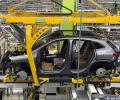
Automobile manufacturers are increasingly vocal about the mounting paperwork and delays associated with India's Production-Linked Incentive (PLI) scheme for the automotive sector, arguing that compliance requirements are becoming as challenging as meeting technical eligibility conditions. They are pushing for a simpler, faster, and more predictable certification and compliance framework.

Tata Motors subsidiary Telco Construction Equipment Company Ltd (Telcon) has opposed a proposal to the Foreign Investment Promotion Board (FIPB) from John Deere for a joint venture with Ashok Leyland to distribute and market its construction equipment in India.

He seems to have fallen from a higher floor of a hotel in Bangkok.

Indian stock market benchmark indices Sensex and Nifty closed nearly one per cent higher, extending their winning streak for a second day. This rally was driven by softening crude oil prices, positive geopolitical developments, and significant buying in blue-chip IT stocks, despite a broader global tech sell-off.

India's outward foreign direct investment (FDI) saw a significant increase of 27.5 per cent, reaching $7.06 billion in March, primarily driven by a sharp rise in guarantees for overseas units, according to the Reserve Bank of India.

Tata Motors on Tuesday said it is looking to offload stake in its finance arm, Tata Motors Finance Ltd, amid report that the country's largest lender SBI may be buying into it.

Among the cars unveiled at the Auto Expo on Wednesday was Mahindra and Mahindra's e-KUV for Rs 8.2 lakhs ex-showroom Delhi. With a single charge range of 150 km and a 55 min fast charging upto 80 pc, it was both a head-turner and a conversation-starter.
Indian benchmark indices Sensex and Nifty rallied in early trade, driven by a significant decline in crude oil prices and positive developments on the geopolitical front, alongside strong performance in blue-chip IT stocks. Track Sensex, Nifty on July 2, 2026
The company is evaluating 'possible areas' of cooperation with Jaguar Land Rover, with the engineering teams at the UK plant as well as at the India centre working in synchronisation.

Retail rates of the fuel will now reflect international movement in oil prices.

RIL is also more profitable than Tata Motors.
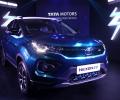
Tata Motors group's investment for this fiscal is pegged at Rs 28,900 crore, mostly for its British arm Jaguar Land Rover (JLR), company chairman N Chandrasekaran said on Friday. The company will also look to raise capital separately for its electric vehicles (EV) business at an appropriate time. It is looking to have 25 per cent of its sales coming from EVs in the medium to long term, up from 2 per cent at present, he said while addressing the company's virtual AGM.

The company is banking on investments lined up for product development and other innovations.
Tata Motors said on Thursday it will invest Rs 10,000 to Rs 12,000 crore (Rs 100 billion Rs 120 billion) in India over the next three to four years and was looking at Russia and China for vehicle sales and component sourcing.

Homegrown auto major Tata Motors on Tuesday said it will hike prices of its commercial vehicles range by 2-2.5 per cent, depending upon individual model and variant, from April 1. The increase in the prices of commodities, such as steel, aluminium and other precious metals -- in addition to higher costs of other raw materials -- has incited this price hike of commercial vehicles, Tata Motors said in a regulatory filing.

The 2026 Tata Tiago EV has faster charging, is more spacious, has more features and a lifetime battery warranty. So how is st still so affordable, wonders Rajesh Alva.

The Argentinian becomes the first brand ambassador of the company in its 70-year history.
Tata Motors, India's biggest bus and truck maker, said it aimed over 10 per cent sales growth this year on the back of rising demand for both light and heavy commercial vehicles.

India's leading passenger vehicle manufacturers are significantly increasing investments and factory capacities, alongside planning major product launches for FY27, driven by strong confidence in sustained domestic demand growth despite global geopolitical tensions and supply chain risks.

Tata Motors on Wednesday expanded its electric vehicle range in the country with the launch of Nexon EV MAX, priced between Rs 17.74-19.24 lakh (ex-showroom). Equipped with a 40.5 kWh lithium-ion battery pack, the Nexon EV Max offers 33 per cent higher battery capacity than the Nexon EV, delivering ARAI certified range of 437 km (under standard testing conditions), ensuring uninterrupted inter-city travel. ARAI refers to Automotive Research Association of India. The model produces 105 kW (143 PS) of power and delivers a torque of 250 Nm, resulting in 0 to 100 sprint times in under 9 seconds.
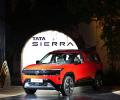
All eyes are now on November 25, when all the specs, varians and pricing will be made known.

With entry-level cars being preferred amid the pandemic, market leader Maruti Suzuki has strengthened its hold, along with Hyundai Motor India.

Tata Motors on Wednesday unveiled Tigor EV, its second electric model in the personal mobility space after Nexon EV. The auto major has tasted success with Nexon EV, which currently commands about 70 per cent market share in the domestic electric vehicle segment. The Tigor EV comes powered by the company's high voltage electric architecture - Ziptron - and has been developed based on three pillars of technology, comfort and safety.

Slym doesn't face such an epic challenge - after all, his company is profitable, has a trustworthy brand, deep pockets and a vast distribution.

Three disappointing experiences with Tata companies made me question whether the group's historic values of customer focus and accountability are slowly fading, notes Dr N Ravichandran.

The company took five years to sell the 250,000 units of the Nano.
Company officials hope that a slew of recent measures will help revive sagging volumes.
From a 15-16-level hierarchy, the organisation is moving to a flat five-level hierarchy.

India's rapidly ageing truck fleet, with 42% of vehicles over 12 years old, is set to trigger a replacement-driven growth of 3-5% annually over the next five years.

The order comes in response to a petition filed by Jaguar Cars Ltd seeking to quash the decision of deputy registrar of Trade Marks, Kolkata.
Tata Motors plans to have 10 new battery electric vehicles (BEVs) in its domestic product portfolio by 2025 as it looks to drive its business model towards sustainable mobility going ahead, as per Tata Motors chairman N Chandrasekaran. In his message to the shareholders, he noted that the auto major aims to be amongst the world leaders in sustainable mobility solutions and as part of that it is also exploring tie-ups in cell and battery manufacturing to secure supplies for its portfolio of green vehicles. "In India, EV penetration in our portfolio has now doubled to 2 per cent this year and we expect penetration to increase exponentially in the coming years. "Tata Motors will lead this change in the Indian market. By 2025, Tata Motors will have 10 new BEV vehicles and as a Group, we will invest proactively to set up charging infrastructure across the country," Chandrasekaran informed shareholders in the company's Annual Report for 2020-21.
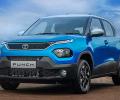
The Tata group flagship has sold more sport utility vehicles (SUVs) in the domestic PV market in the past four months than any other automotive manufacturer, cementing its no.1 spot. It first grabbed pole position in the SUV segment in October 2021 after the launch of the Punch - a sub-compact SUV offering.

This is the third consecutive monthly slide.

Tata Motors is India's largest automobile company, with consolidated revenues of Rs 1,65,654 crore (Rs 1.65 trillion)

Years after the Nano exit, Singur's farmers now seek industry and jobs, as the land remains caught between failed promises and political contest.

Cars like the Land Rover Evoque, endorsed by Victoria Beckham, have more women customers than men.

A pickup in freight rates, rising fleet utilisation and a long-awaited replacement cycle are breathing fresh life into India's commercial vehicle (CV) market, strengthening the investment case for Tata Motors' CV arm (TMCV). Despite a broadly steady December quarter (Q3) performance, brokerages remain divided on whether the upswing is strong enough to offset margin pressures.

Bengaluru-based electric air taxi startup Sarla Aviation has received Design Organisation Approval (DOA) from the Directorate General of Civil Aviation (DGCA), a crucial step towards commercial production of its indigenous electric vertical take-off and landing (eVTOL) aircraft. The company also inaugurated its new headquarters and announced partnerships, highlighting India's growing capabilities in advanced aerospace technology.

The Delhi government has approved the Delhi EV Policy 2.0, which will phase out fresh registrations of internal combustion engine (ICE) two-wheelers and three-wheelers over the next two years, starting with a ban on ICE 3Ws and N1 category LCVs from January 1, 2027, and ICE 2Ws from April 1, 2028.
